
Have you ever considered a Corporate Power Purchase Agreement (CPPA)? If you have not come across them yet, a CPPA is essentially a long-term agreement that allows you to buy energy from an energy producer (often clean energy or renewables developer). These types of agreements have grown in significance over the years and are becoming an important part of energy procurement strategies for manufacturers across the UK, particularly as businesses actively look for smarter ways to take control of their power and hedge against energy price volatility.
But why now? Well, CPPAs give businesses greater price certainty and help to reinforce sustainability credentials whilst simultaneously providing a potential avenue for cost savings over time. The UK Government are increasingly encouraging decentralised energy and this, coupled with rising emissions, including carbon, costs alongside lower prices for wind, solar and other clean technologies, mean that manufacturers are able to benefit from engaging directly with renewable energy projects.
How does a CPPA work?
Corporate Power Purchase Agreements act as a long-term contract between a buyer (you) and a supplier (the generator). In many models, there is also a utility or licensed energy provider involved to handle the grid balancing and energy delivery. These agreements typically last 10-15 years, providing stable, predictable pricing that enables separation from market volatility.
There are three main CPPA structures that businesses typically utilise:
- Private wire/onsite/direct PPA – Power comes directly from a co-located or nearby renewable source, such as rooftop solar panels, wind turbine, a biomass or anaerobic digestion plant, or other embedded power generation which is directly connected (via a private wire/cable) to the off-taker (i.e. the manufacturer).
- Sleeved PPA – Power is generated by a generator at an off-site power station, then passed through the grid and handled and delivered by a licensed energy supplier to the end customer.
- Virtual/Synthetic or financial PPA – In this structure, there’s no physical energy transfer. Instead, the parties agree on a fixed “strike price” and settle the difference with market pricing.
Generally, most manufacturers in the UK would use a private wire/onsite/direct PPA or a sleeved structure.
Private wire/onsite/direct PPA
This PPA structure involves a physical cable connection between a power generator, which is typically located in close proximity to or even on a manufacturer’s site. In most circumstances, all energy generated by the generator is fed into the manufacturer’s premises – the energy supplied is not subject to the same grid-associated costs as if the energy was supplied by a licenced supplier via the licensed grid network. Manufacturers tend to lock in a specific PPA price, which, in most cases, is lower than energy prices for grid energy and will use this PPA in conjunction with back-up and top-up power from a licensed supplier via the grid.
Correctly dealing with excess electricity under this form of PPA is also crucial so that the arrangement does not present an energy regulation risk from a licence exemption perspective to the off-taker (i.e. the manufacturer). If a project is designed specifically for your requirements on-site, additional project development risks need to be taken into account such as reaching the commissioning and operation by an agreed commercial operation date and dealing with project delays and other issues such as grid connection, consenting and permitting.
Sleeved PPAs/Virtual/Synthetic PPAs
There are also PPAs knows as Sleeved or Virtual/Synthetic PPAs. These provide similar benefits to a private wire/onsite/direct PPA, but they work a little differently. Instead of being directly connected to a business premises, these PPAs route electricity through the licensed national grid, but the user goes through an intermediary (i.e. a licensed supplier) who handles the balancing and delivery of the power and ensures that the manufacturer is credited with renewable supply and fixed pricing that matches the output of a particular generator or generation site. Through these arrangements, both the end customer (i.e. manufacturer) and the generator obtain long term price certainty on the energy supply, and the intermediary (i.e. licensed supplier) receives a “sleeving fee” for their services.
The rise in CPPA adoption across the manufacturing sector
More and more manufacturers are beginning to make use of CPPAs as a way to address the challenges they face in energy procurement. These agreements provide a number of different benefits that help to strengthen other business elements, too.
CPPAs can help manufacturers hedge against wholesale energy price volatility. CPPAs tend to be more expensive in the short term, however, they can work out cheaper in the long term. As we have discussed in previous articles, this energy price volatility has become a major hurdle for business across the country, and with the ability to negotiate lower-than-market fixed prices or index-linked pricing with clear caps/floors, manufacturers can gain strong price certainty over a set period of time. However, it’s still important to make sure that contracts account for any future changes to regulation, transmission charges, subsidy schemes etc.
ESG and decarbonisation also play a leading role in the wider adoption of CPPAs. They provide traceable, project-specific renewable energy, rather than generic green tariffs. This means that manufacturers can further pursue meeting their emissions targets, as well as satisfying ESG reporting frameworks. Alongside this, a CPPA can help to demonstrate environmental leadership to investors, customers, competitors, and regulators as well as their own staff, and also unlock access to green finance or preferential procurement terms.
Is a CPPA right for you? What to look out for
A CPPA is a complex commercial and legal arrangement which means that having access to specialist input is crucial. It is therefore essential to understand key risk areas and negotiation points when considering whether or not a CPPA is for you.
As with any strategic change, it’s important to determine whether it is a change that will provide you with a positive outcome. Proper planning is key, and as we have mentioned previously, that means asking and answering a number of questions from the outset. Your energy demand as well as general corporate strategy plays a big part in this respect, as getting the most out of a CPPA typically means having the ability to forecast your energy needs for the next 10 to 15 years.
You need to determine whether you are able to commit to a long-term contract or not. As you may be an anchor off-taker for a power generator (i.e. the PPA or CPPA being a key contract which underpins project revenues and generally the entire financial business case of the power generator). Exit/termination clauses can be particularly complex and flexibility for both parties is not always easy to achieve. How much of your load does the PPA cover, and what happens if your demand falls from situations such as factory changes or downturns? Volume commitments, take-or-pay arrangements as well as potential power project curtailment all have an impact on whether or not a CPPA is for you.
You also need to carefully look at exit and termination rights. When reviewing your CPPA contracts, keep an eye out for break clauses, early exit fees and other termination consequences and rights to transfer if your business structure changes. Alongside exit terms and termination consequences, you will also need to think about counterparty risk (i.e. what is the financial covenant strength of the generator), particularly as generators may be in the early stages of their project without an extensive balance sheet, often required to service debt from energy revenues.
Project lenders or investors will often require step-in rights in case of a failure to perform by the generator, but also require additional guarantees or other forms of security to ensure an off-taker (i.e. manufacturer) complies with their obligations (i.e. mainly payment obligations). It is important to ensure you carry out careful due diligence on the generator and the project structure and, where necessary, put in place sufficient additional security to ensure obligations under the PPA or CPPA are complied with.
There are also site ownership/control questions for those who may be pursuing a private wire/onsite/direct PPA. These models often require planning permission, grid connection rights, access and other land rights, depending on the nature of the agreement. From a legal and bankability perspective, it is critical to consider and be able to meet all necessary requirements as they will go hand in hand with the actual PPA or CPPA.
Then there are performance and delivery risks to consider – what happens if the generator underperforms? Are there any “make-whole” payments or backup supply guarantees? Your ability to continue business operations is reliant on the generator being able to provide you with sufficient energy when you need it.
Greenwashing can still be an issue in CPPAs. It’s important to ensure that your contract delivers legitimate, auditable renewable credentials, and that there is no greenwashing or double counting. Many businesses have fallen into the trap of greenwashing in recent years, and it can have a significant impact on the reputation and performance of a business. You also need to consider dispute resolution and change in law provisions, so that you can effectively renegotiate if there are any shifts in key market conditions.
Changing from energy buyer to energy partner
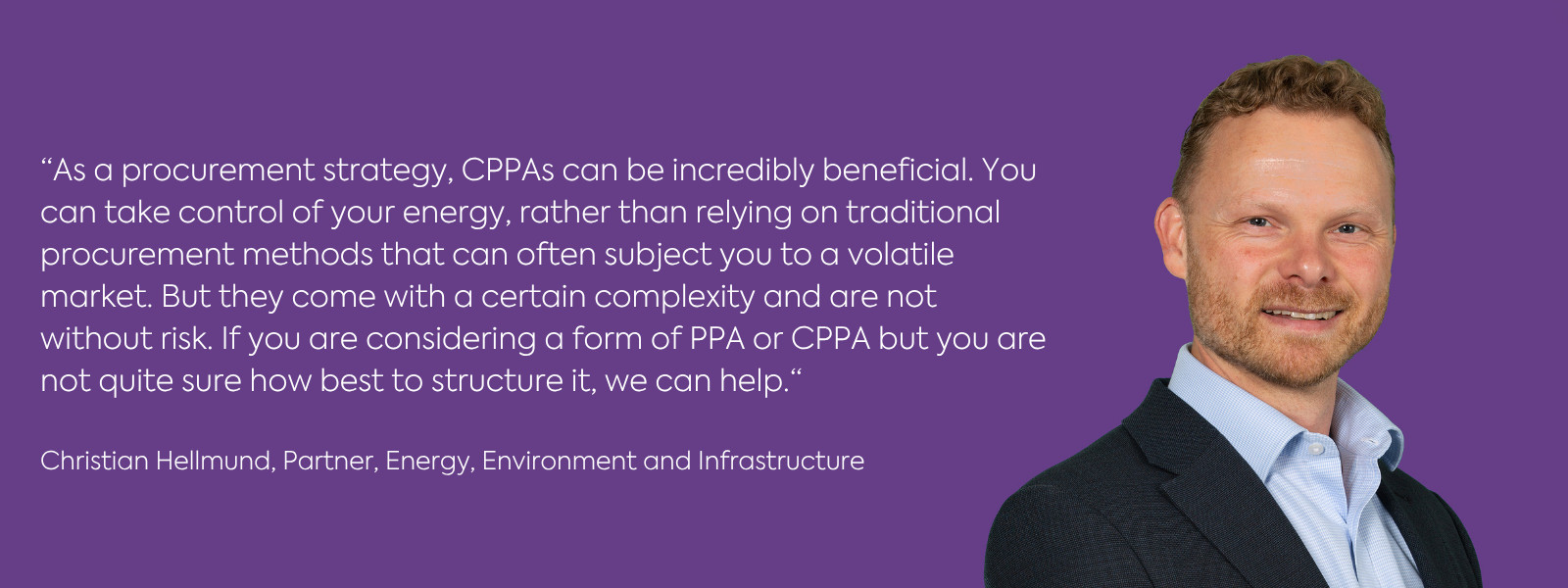
As a procurement strategy, CPPAs can be incredibly beneficial. You can take control of your energy, rather than relying on traditional procurement methods that can often subject you to a volatile market. But they come with a certain complexity and are not without risk. If you are considering a form of PPA or CPPA but you are not quite sure how best to structure it, we can help.
Get in touch with a member of our Energy, Infrastructure & Projects team to find out more about how we can support you to structure your energy procurement.