
Businesses in the manufacturing sector are no stranger to having to “do more with less”, and today, in the volatile realm of energy and costs management, that statement is a consistent reality for countless organisations. The fact is, energy is no longer just an overhead. Because aside from being a utility cost, it holds a critical place as a strategic issue that directly impacts everything from productivity and compliance to remaining competitive and developing long-term resilience.
Between 2021 and 2023, the UK manufacturing sector saw average electricity prices rise by nearly 50% (ONS/BEIS), and whilst the wholesale costs have somewhat stabilised, the structural volatility that has occurred in recent years is showing no signs of making a departure. For businesses, that means it’s time to take a new approach to energy. An approach that acknowledges and adapts to the new energy landscape as an issue that affects every part of the business and operations.
Why energy matters for UK manufacturers in 2025 and beyond
Despite the slight stabilisation of prices, energy costs are unfortunately still volatile. We’ve witnessed a drop in wholesale prices since their peak in 2022, but they still remain above 2019 levels. This volatility has been, and continues to be, driven by global fuel markets (often affected by geopolitical shocks), constraints of the grid and spikes in demand, existing and evolving climate policy, and more This places significant strain on energy-intensive manufacturers who have a greater degree of exposure to the challenges of compliance and cost
There’s also growing pressure on regulatory and sustainability obligations. With the UK’s Net Zero Strategy and Industrial Decarbonisation Strategy, including the Clean Power 2030 action plan, highlighting the need for energy efficiency and carbon reduction, manufacturers are consistently required to revise their energy strategies on a frequent basis. These reviews include the need to consider Scope 1 (direct – emissions that result from activities owned or controlled by a company), Scope 2 (energy – indirect emissions generated from the consumption of purchased electricity, steam, heating, and cooling by a company, but produced by a third-party energy provider), and increasingly Scope 3 (supply chain – indirect greenhouse emissions as a result of activities from assets now owned or controlled by the reporting company, but are related to its operations) emissions, as well as meeting carbon reporting requirements for larger businesses under the current Streamlined Energy and Carbon Reporting (SECR) and future UK green taxonomy. It’s important to note that current SECR requirements relate to certain entities or a certain size – it does not apply to every entity, such as smaller manufacturers. More importantly, existing SECR requirements are currently under consultation and will likely be replaced with the UK Sustainability Reporting Standards (UK SRS) which will require a wider range of sustainability disclosures. We will provide further updates after the consultation process has closed in mid-September 2025.
Alongside these, new challenges are on the horizon, particular for exporters to the EU who will face potential carbon border taxes. Modelled on the EU Carbon Border Adjustment Mechanism (CBAM), the UK is looking to implement its own UK CBAM, due to come into force on January 1, 2027. Manufacturers should get themselves familiar with EU CBAM and UK CBAM, the relevant compliance, reporting obligations and timelines, as well as their position in the supply chain and interrogate their own supply chain downstream so as not to face competitive disadvantages in their respective markets.
Then there’s the element of customer and investor demands. An increase in demand for emissions data from customers and their own suppliers is one element that manufacturers need to actively manage. These demands also impact a business’ ability to access finance from banks and investors embedding ESG considerations into loan covenants and procurement requirements. And what about reputation? All businesses understand the importance of a positive reputation, and public perception is directly influenced by energy, sustainability and ESG matters. It is also a critical element of recruitment, where visible and effective energy and sustainability strategies are an important part of workforce expectations and retention of crucial talent within the workforce. Also, the additional regulation and requirements for reporting and compliant will have a significant overall impact on baseline costs.
A turning point for Yorkshire manufacturing
Long have the collective Yorkshire counties been at the heart of the UK’s manufacturing sector. Countless locations from North to South, East to West, act as industrial hubs that drive the sector and national GDP forwards. As an example, the Humber region is the UK’s largest industrial cluster, whilst South Yorkshire is synonymous with steel, automotive components and glass, and West Yorkshire is home to advanced textiles, engineering, food processing and more.
These regions, as well as others across the county, are actively placing decarbonisation and cleaner energy towards the very top of their priorities with projects and mechanisms such as carbon capture and storage (CCUS) and hydrogen (H2) infrastructure rising on the East Coast, greater collaboration between industry and academia through Net Zero North, and more policy engagement opportunities for manufacturers through the Yorkshire & Humber Climate Commission. Given the notable size of the county’s manufacturing clusters proportionately to the rest of the country, it becomes easy to see why that priority is an essential aspect of achieving the UK’s overall decarbonisation goals.
Now is the time to adapt, and we’re here to guide the way
Whilst progress is well underway for changing the way energy is addressed across the manufacturing sector, for businesses who may be reviewing their strategies either now or in the near future, the way forwards isn’t always as straightforward as it may seem.
That’s why we’re putting together a multi-part series to talk about the ways in which you can begin to navigate the different challenges and crossroads that stand in the way of your energy and decarbonisation strategies. Starting with this brief introductory piece discussing the importance of energy and energy strategy within the manufacturing sector, we’ll also be providing guidance on:
- Smart energy and optimisation – When it comes to managing costs and reducing energy consumption, optimisation and technology plays a crucial role. Part 2 discusses how you can use and develop effective strategies using AI, IoT, and data analytics to work towards achieving your energy and sustainability goals.
- Procurement strategies – Acquiring energy that works for you is a vital aspect of your energy strategy. So, in part 3, we will talk about different types of procurement strategies, navigating fixed, flexible and group purchasing, contract pitfalls, and provide you with a collection of legal tips for managing third-party intermediaries.
- Power Purchase Agreements (PPAs) and Corporate Power Purchase Agreements (CPPAs) – For part 4, as a specific energy procurement route we’ll talk about how you can directly engage with renewable energy generators and suppliers with PPAs and CPPAs – a powerful tool both for locking in energy prices as well as enhancing your organisation’s ESG performance.
- Have your say – We want to know what matters to you. For the fifth and final part in our Energy in Manufacturing series, we’ll finish with a short feedback piece where you‘ll have the opportunity to make your voice heard about your priorities, concerns, and strategies for your own energy, decarbonisation and sustainability journey.
Your energy decisions matter
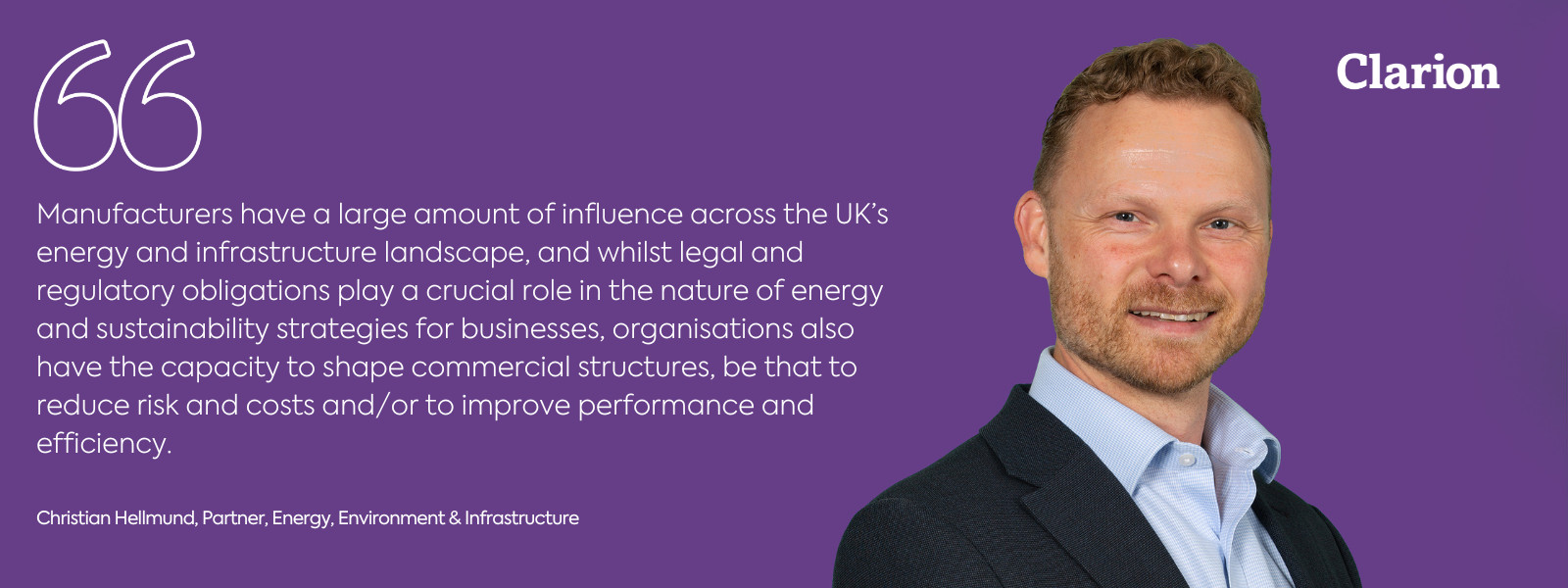
Manufacturers have a large amount of influence across the UK’s energy and infrastructure landscape, and whilst legal and regulatory obligations play a crucial role in the nature of energy and sustainability strategies for businesses, organisations also have the capacity to shape commercial structures, be that to reduce risk and costs and/or to improve performance and efficiency.
With that in mind, over the coming weeks, our manufacturing and energy law specialists will share their insights so that you can make more strategic, smart choices and seize sustainability opportunities, both now, and for the long term.
To find out more about how your business can manage energy risk and opportunity, please don’t hesitate to get in touch with our manufacturing and energy, infrastructure and projects law experts.