
A Supreme Court decision this week is a reminder of the need when negotiating contracts to think about why any provisions are being made conditional, and the consequences if the condition is not performed. While such provisions are not uncommon, what if the other party wrongfully causes the condition never to be fulfilled?
Background to the case
The point arose in the case of King Crude Carriers SA v Ridgebury November LLC [2025] UKSC 39. The case involved contracts to supply ships, with the buyers agreeing to pay a 10% deposit to a deposit-holder. This was to be paid within 3 banking days of the deposit-holder confirming that the deposit account had been opened. However, this event did not happen because, while parties were obliged to provide all necessary documentation for the opening of the account, the buyers failed to do so.
The contractual issue
On termination, the question was whether the seller had a debt claim against the buyers for unpaid contractual deposits, rather than a claim in damages. The Supreme Court held that it did not, and that, subject to any contrary terms, where a condition precedent had not been fulfilled because of the debtor’s breach of contract this was something that could be addressed through a claim for damages.
The law
No deemed fulfilment of payment pre-condition
In reaching this conclusion, the Supreme Court held there was no principle in English law that where a party wrongfully prevents the fulfilment of a condition precedent (ie a pre-condition) to its debt obligation, that condition is deemed to be fulfilled. This principle had been expressed by Lord Watson in the nineteenth century case of Mackay v Dick (1881) 6 App Cas 251 and, while there had been doubts about its status, the position that it is not part of English law is now settled.
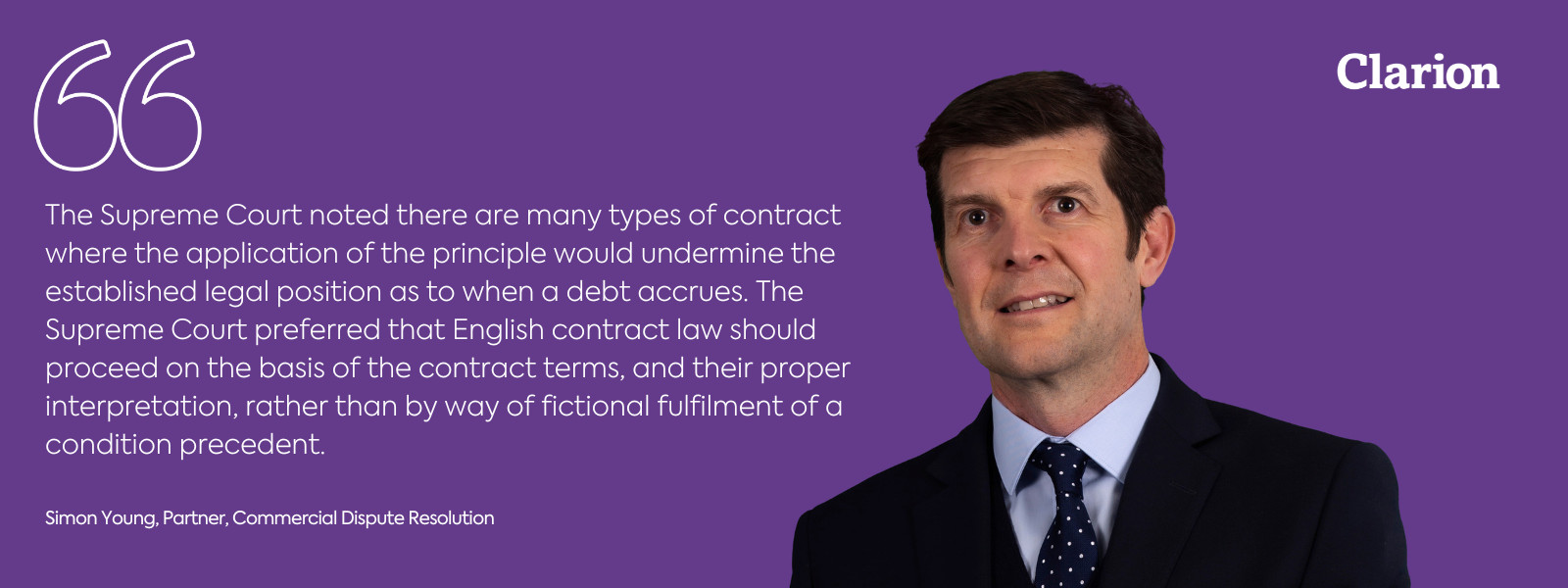
The Supreme Court noted there are many types of contract where the application of the principle would undermine the established legal position as to when a debt accrues. The Supreme Court preferred that English contract law should proceed on the basis of the contract terms, and their proper interpretation, rather than by way of fictional fulfilment of a condition precedent.
Contractual interpretation
In addition to finding that there was no Mackay v Dick principle in English law, the Supreme Court referred to the modern objective and contextual approach to contract interpretation, and rejected the idea that in contractual interpretation there was a general presumption that a party could not take advantage of its own wrong.
Here, proper interpretation of the contract did not mean that the conditions precedent to the buyer’s debt obligation were to be ignored because of the buyer’s breach in respect of the conditions precedent. Significantly for contract draftsmen, the judgment noted “It is always open to the parties to include a term in the contract making clear that a condition precedent to a debt obligation does not apply where the failure of the condition precedent is caused by the debtor’s breach.”
The Supreme Court also rejected the seller’s alternative argument that the deposits were due when the contract was made with the conditions precedent relating only to time for payment.
Implications
This decision emphasises the need to be aware of the impact of contractual terms, including conditions precedent. As the Court said when considering the deposit:“If the parties intended it to be paid regardless…they would not have made it conditional.”
The Supreme Court was clearly moved by the need for the law to support predictability in commercial arrangements. For their part, businesses need to reflect on the implications of contract terms and ensure they understand what their position will be if a condition precedent is not fulfilled. Clear drafting avoids many later arguments. It was relevant in this case that the buyers were not relying on the breach to treat the contract as at an end or to claim a benefit under it, as the court left open the possibility of the presumption of not profiting from your own breach applying in this context if it could be said to reflect the parties’ intention, and we may therefore see future decisions testing this.
If you have any questions about the topics raised in this blog, please contact our Commercial Dispute Resolution team.